


Grower's Handbook
Pump County · Bureau of Agricultural Statistics
The chart is the weather. Every crop in this county is a live token. Sowing a field opens a position in it, the market overhead decides how it grows, and the grain you take in is your claim on a pot of fees that everyone shares. This handbook covers the whole loop, in the order you will meet it.
0 · The road in
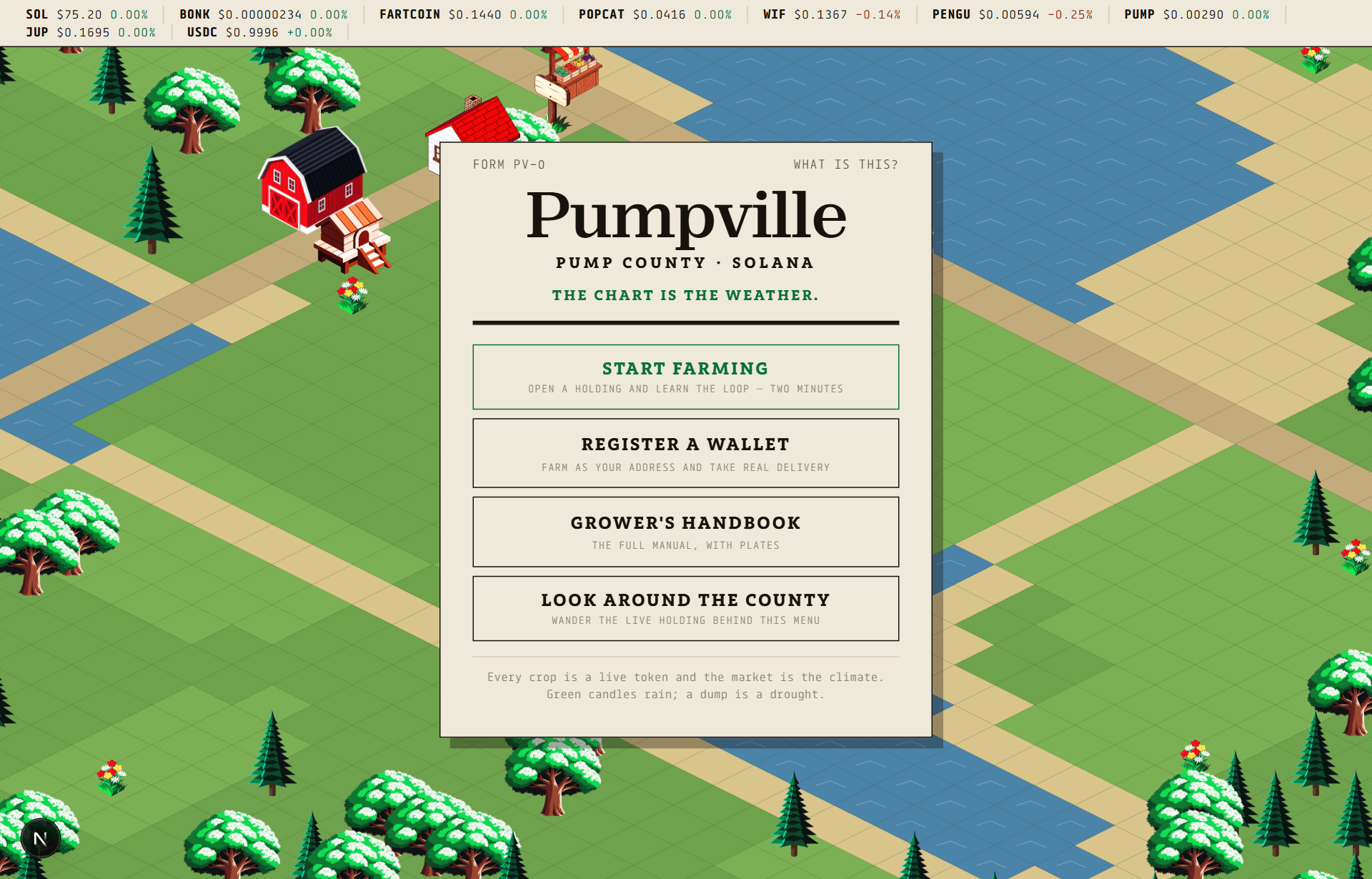
menu and walkthroughFrom the menu, Start Farming opens a holding at once — no wallet needed — and drops you into a nine-step walkthrough of the whole loop on a trainer crop that grows in two minutes. The card on the right of the screen explains each step and advances itself as you actually do the thing; nothing moves it but you. Register a wallet whenever you want the county to be able to pay you.
1 · The county
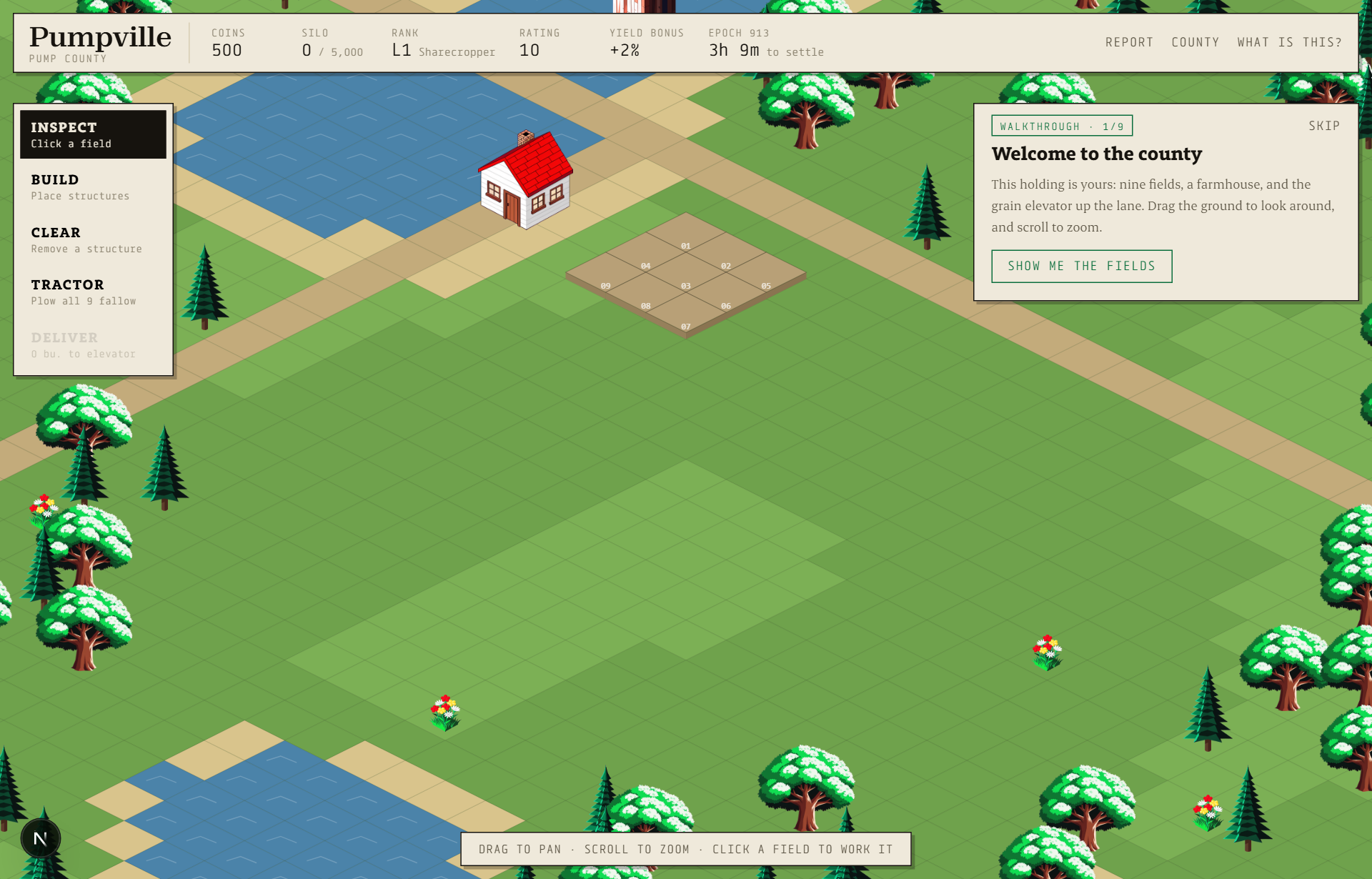
where you areYou arrive on a holding: a block of fields, a farmhouse, and the county elevator up the lane. Drag to look around and scroll to zoom. Your fields carry numbers; everything else is scenery or a structure you placed. The bar along the top is your purse, your storage, your rank and the clock to the next settlement.
2 · Plow, then sow
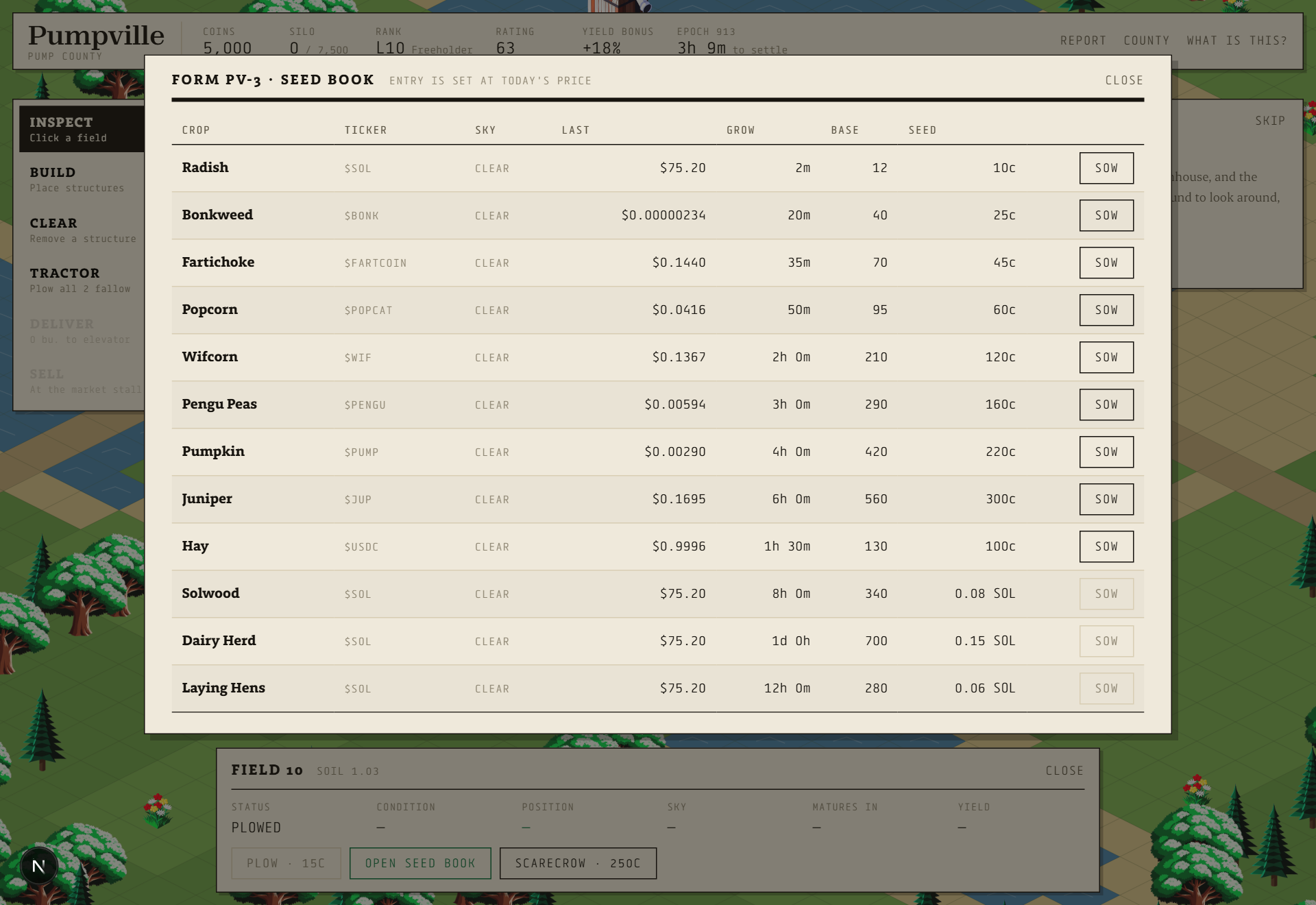
opening a positionA fallow field must be plowed before anything will take — 15 coins, or use the Tractor to plow every fallow field at once. Then open the seed book and choose a ticker. The price at that moment becomes your entry, and you are long that token until you take the crop in.
Crops come in four classes. Higher ranks unlock the better ones.
| Crop | Ticker | Class | Grow | Base yield | Seed | Lvl |
|---|---|---|---|---|---|---|
| Radish | $SOL | ROW | 2m | 12 | 10c | 1 |
| Bonkweed | $BONK | ROW | 20m | 40 | 25c | 1 |
| Fartichoke | $FARTCOIN | ROW | 35m | 70 | 45c | 2 |
| Popcorn | $POPCAT | ROW | 50m | 95 | 60c | 3 |
| Wifcorn | $WIF | FIELD | 2h 0m | 210 | 120c | 3 |
| Pengu Peas | $PENGU | FIELD | 3h 0m | 290 | 160c | 5 |
| Pumpkin | $PUMP | FIELD | 4h 0m | 420 | 220c | 4 |
| Juniper | $JUP | FIELD | 6h 0m | 560 | 300c | 7 |
| Hay | $USDC | FIELD | 1h 30m | 130 | 100c | 2 |
| Solwood | $SOL | ORCHARD | 8h 0m | 340 | 0.08 SOL | 6 |
| Dairy Herd | $SOL | LIVESTOCK | 1d 0h | 700 | 0.15 SOL | 9 |
| Laying Hens | $SOL | LIVESTOCK | 12h 0m | 280 | 0.06 SOL | 8 |
- ROW — Fast, cheap, violently weather-exposed.
- FIELD — The working acreage. Longer, steadier, worth more.
- ORCHARD — Perennial. Regrows in place and never rots.
- LIVESTOCK — Weather-immune. Produces on a fixed cycle.
3 · The weather is the chart
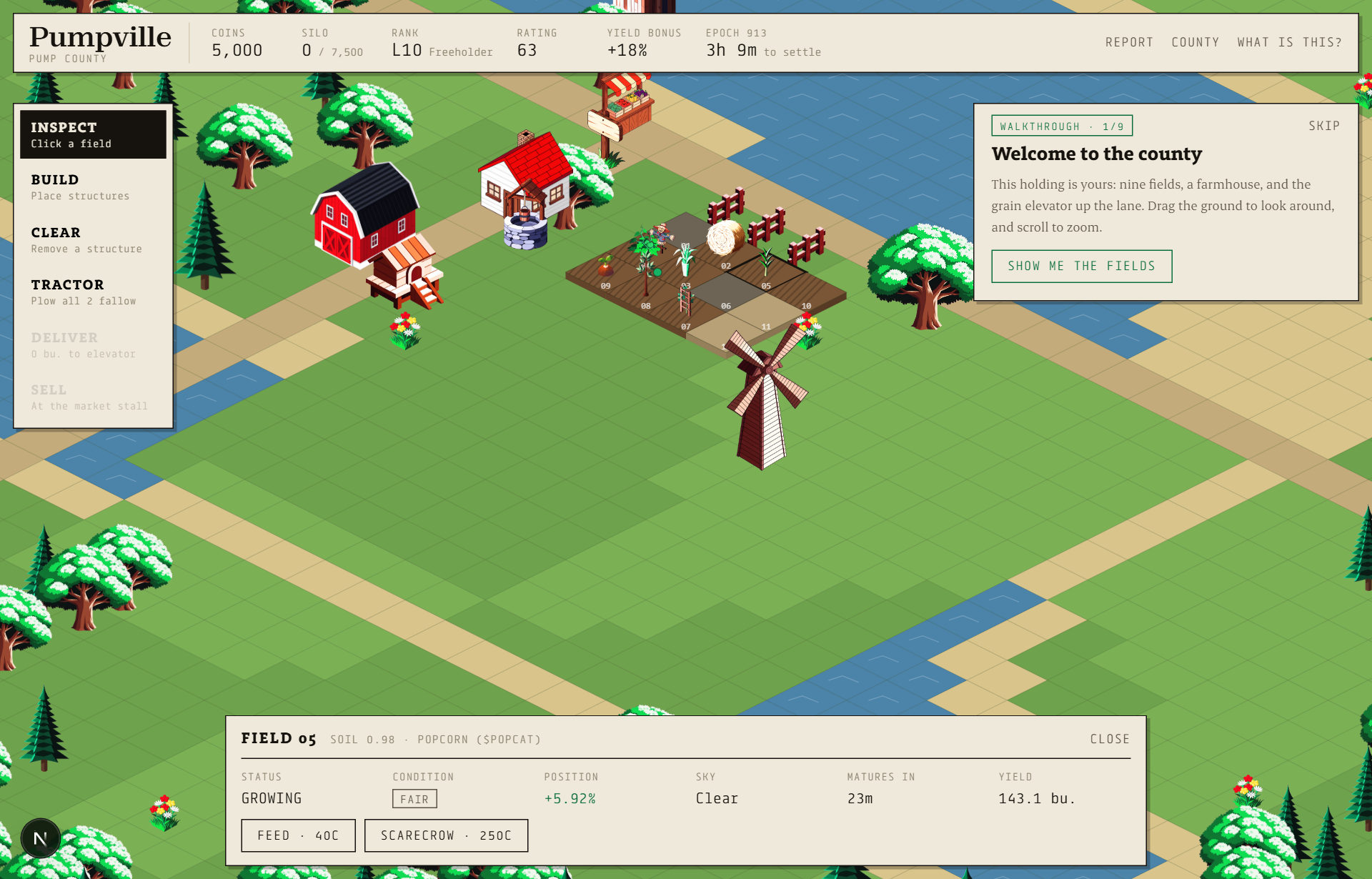
why your crop grows or doesn'tEvery ticker has a sky, taken from its live price action and shared by everyone farming it. A green run brings rain and the crop races; a slide brings drought and it stalls. Growth is integrated over the whole history of the field, so a late pump does not undo a week spent in the dust.
| Sky | Comes from | Growth | Effect |
|---|---|---|---|
| BUMPER | A large green candle | 160% | Growth races; a district-wide yield event. |
| RAIN | Rising price | 135% | Growth accelerates and moisture climbs. |
| CLEAR | Flat | 100% | Nominal growth. |
| DROUGHT | Falling price | 55% | Growth stalls and moisture drains. A well softens this. |
| HAIL | A sharp drawdown | 80% | Standing crops take damage; each strike costs a fifth of the yield. |
| LOCUSTS | A collapse | 0% | The crop is destroyed outright. Clear the field and start again. |
4 · Take it in before it rots
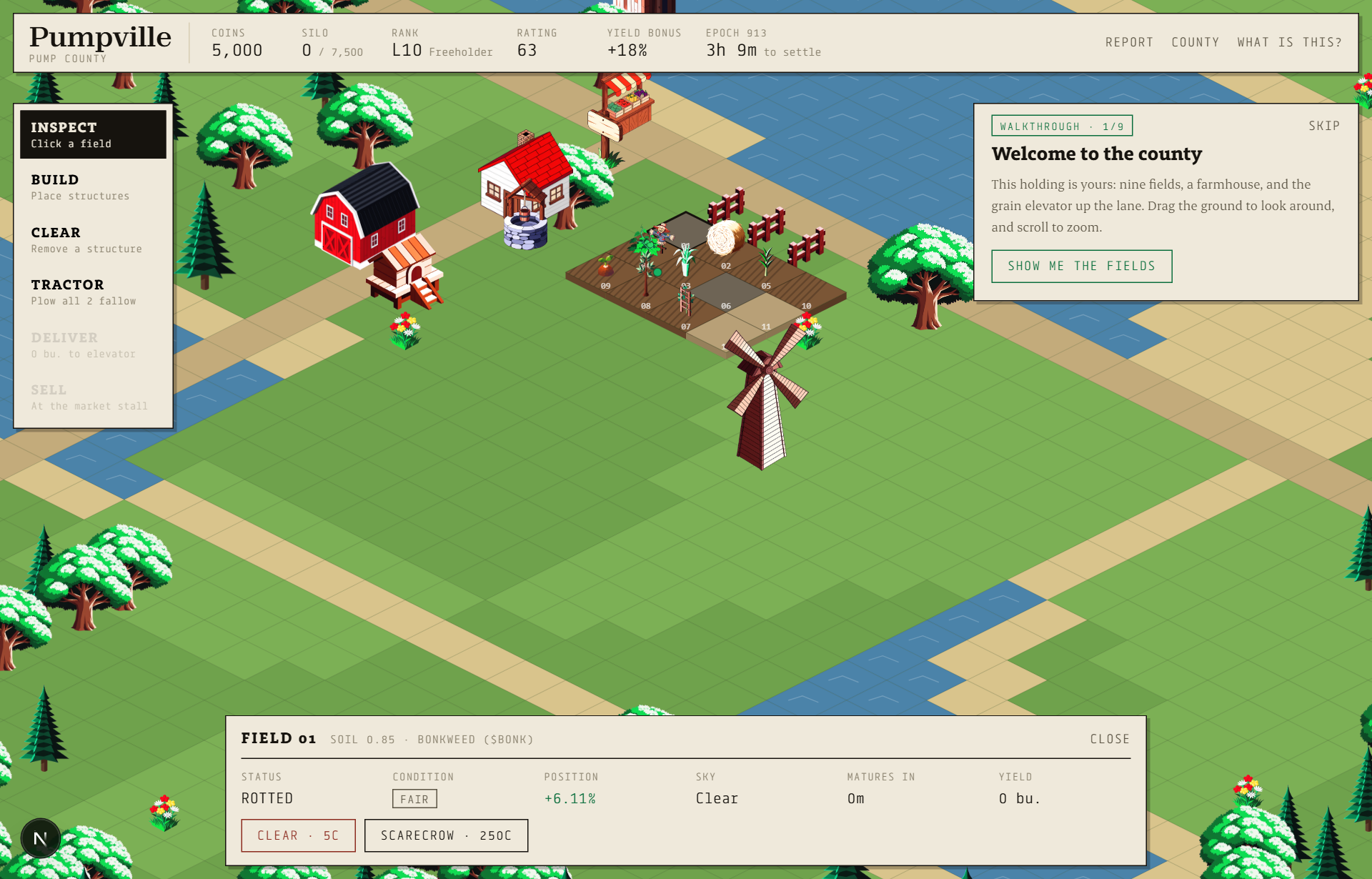
the harvest windowA matured crop does not wait. The harvest window is 50% of the crop's grow time; miss it and the field rots, pays nothing, and must be cleared for 5 coins. A scarecrow (250c) adds another 100% of grace. Feeding a growing field (40c) multiplies its yield by 1.25.
Perennials and livestock never rot: an orchard regrows in place and a herd simply produces again on its cycle.
5 · Bushels, the elevator, settlement
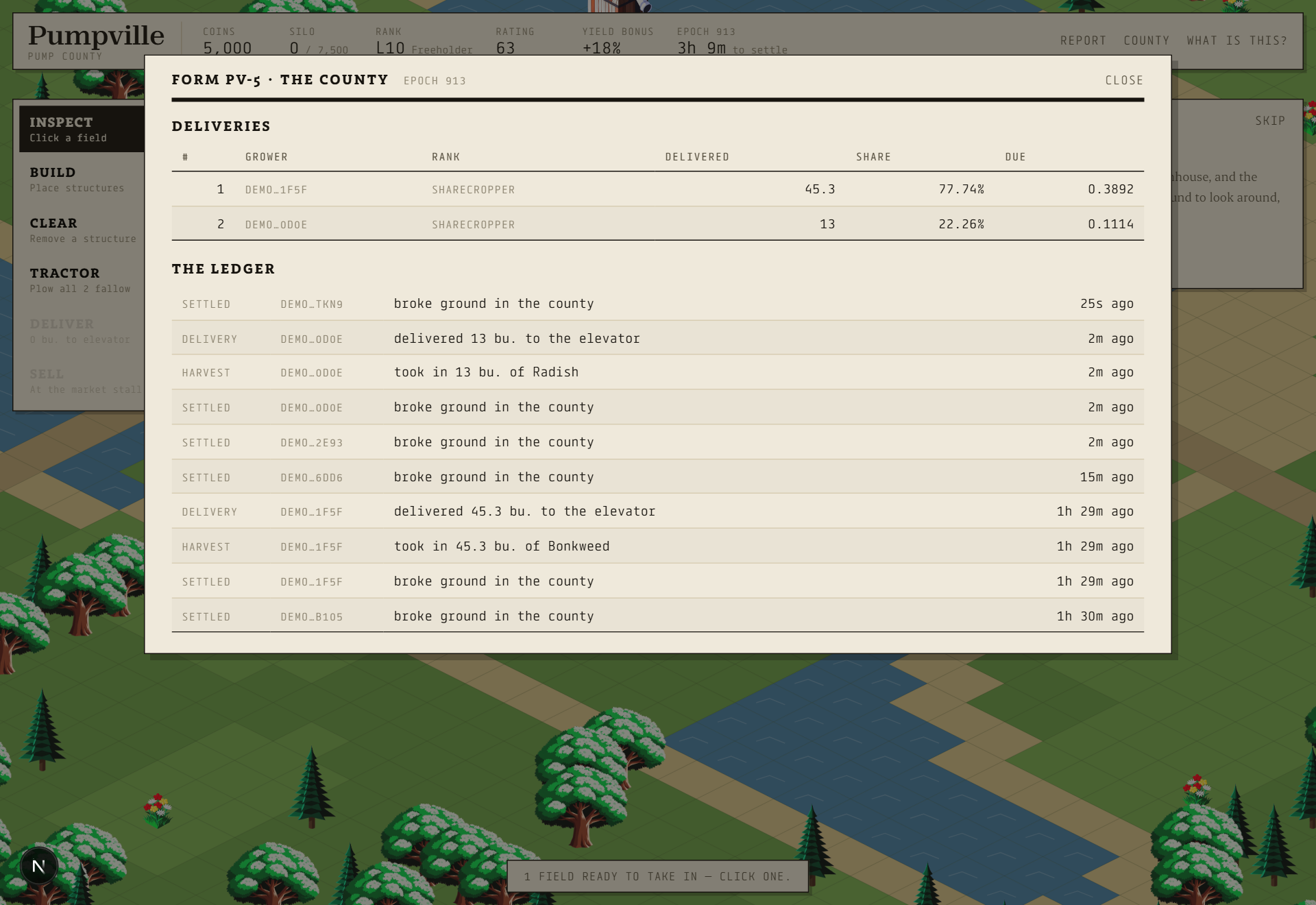
how you actually get paidA harvest yields bushels — a quantity, not money. How many depends on your entry, the weather since, your soil grade, whether the field was fed, your rank, and any hail it took. Bushels go to your silo, and from there you deliver them to the grain elevator.
Every fifteen minutes the epoch closes. The accrued fee pot is divided by every bushel delivered in that epoch, and the quotient is the settlement price:
settlement price = pot ÷ all bushels delivered
your payout = your bushels × settlement price
This is the whole game in one line: the chart decides your share, and the fees decide the pot. A great harvest in an epoch when everyone had a great harvest pays badly. A modest harvest in a drought epoch pays well. Grain held back in the silo spoils 0% per epoch, so storing it is a real bet that the next epoch pays better by more than the rot.
6 · Build the holding up
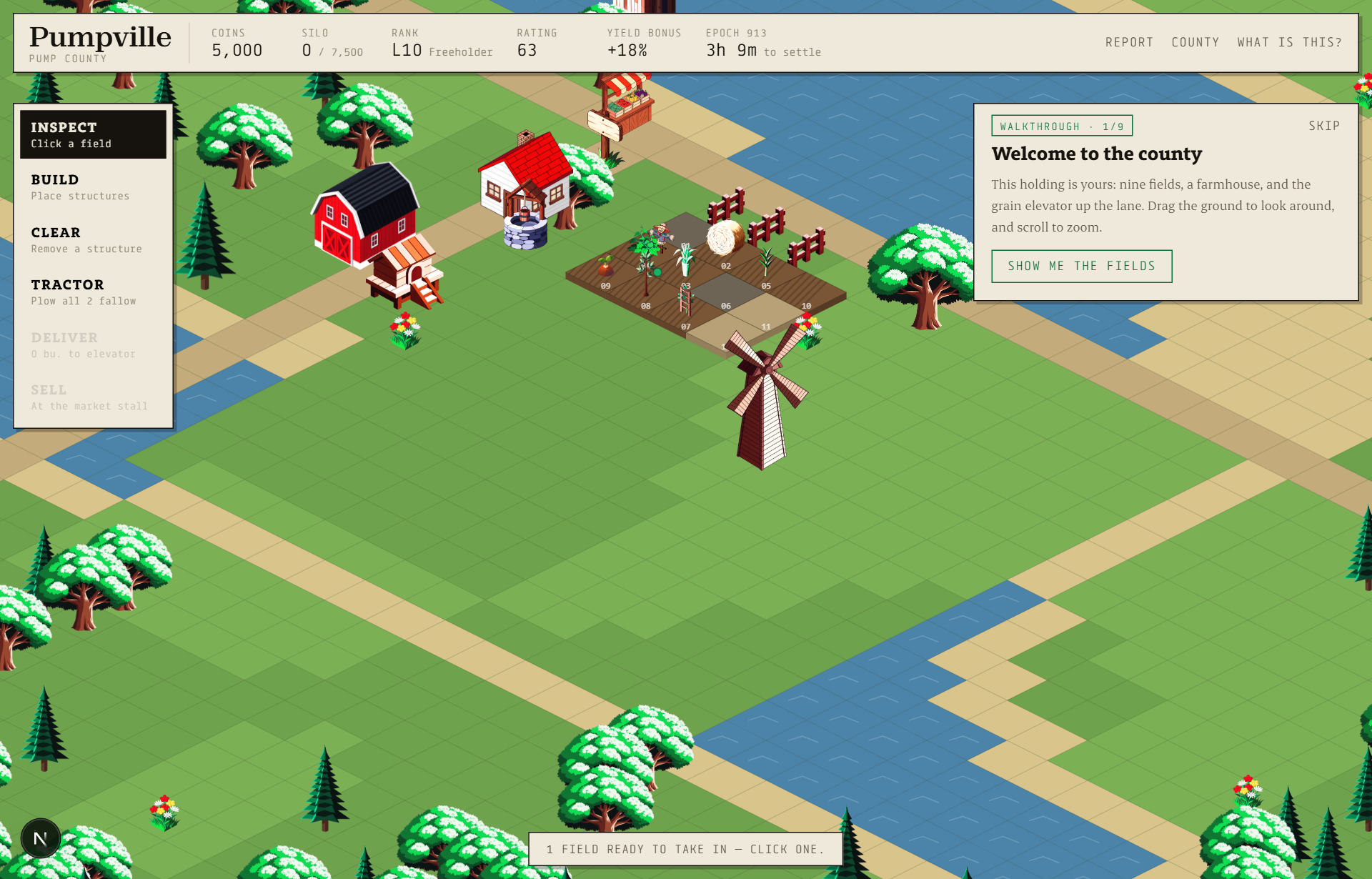
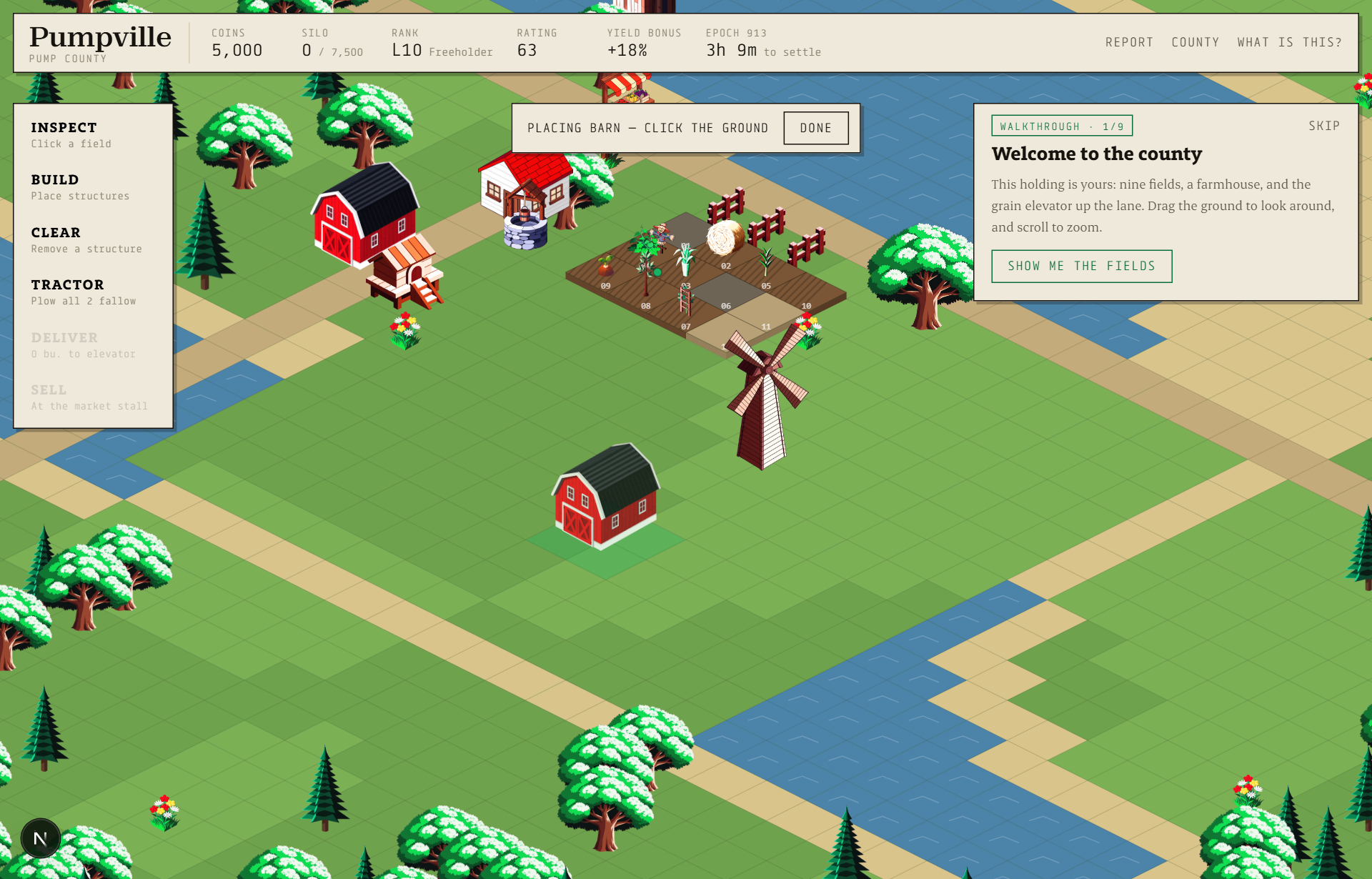
structures do real workNothing you place is purely ornamental. Barns and silos raise how much grain you can hold, a windmill adds to every harvest, a well softens drought, and decorations feed Farm Rating, which converts into a yield bonus of its own.
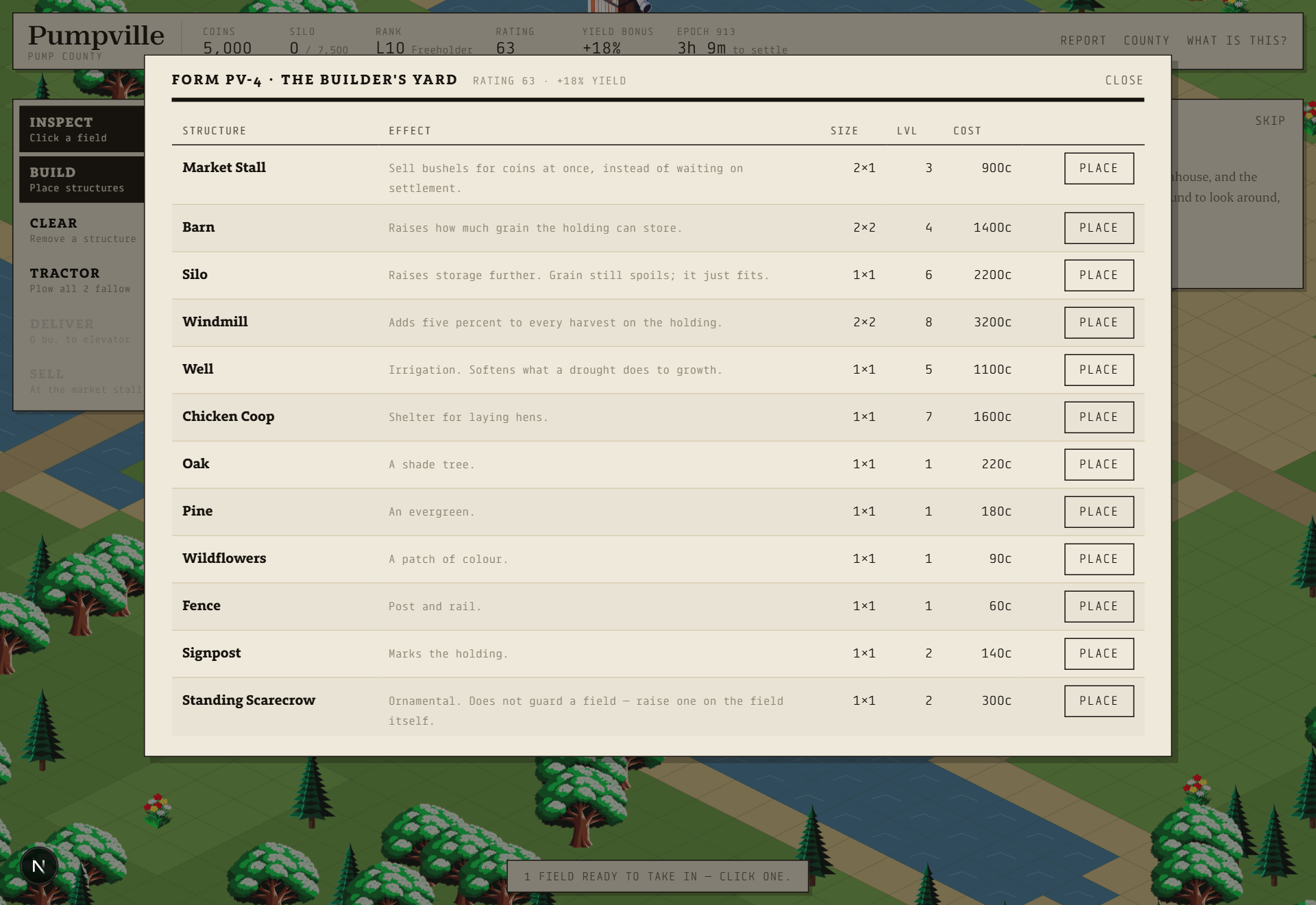
Choose a structure, then click the ground. The footprint shows green where it will go and red where it will not — you cannot build on water, on a worked field, or on top of something else.
| Structure | Does | Size | Lvl | Cost |
|---|---|---|---|---|
| Market Stall | Sell bushels for coins at once, instead of waiting on settlement. | 2×1 | 3 | 900c |
| Barn | Raises how much grain the holding can store. | 2×2 | 4 | 1400c |
| Silo | Raises storage further. Grain still spoils; it just fits. | 1×1 | 6 | 2200c |
| Windmill | Adds five percent to every harvest on the holding. | 2×2 | 8 | 3200c |
| Well | Irrigation. Softens what a drought does to growth. | 1×1 | 5 | 1100c |
| Chicken Coop | Shelter for laying hens. | 1×1 | 7 | 1600c |
| Oak | A shade tree. | 1×1 | 1 | 220c |
| Pine | An evergreen. | 1×1 | 1 | 180c |
| Wildflowers | A patch of colour. | 1×1 | 1 | 90c |
| Fence | Post and rail. | 1×1 | 1 | 60c |
| Signpost | Marks the holding. | 1×1 | 2 | 140c |
| Standing Scarecrow | Ornamental. Does not guard a field — raise one on the field itself. | 1×1 | 2 | 300c |
7 · Reading the report
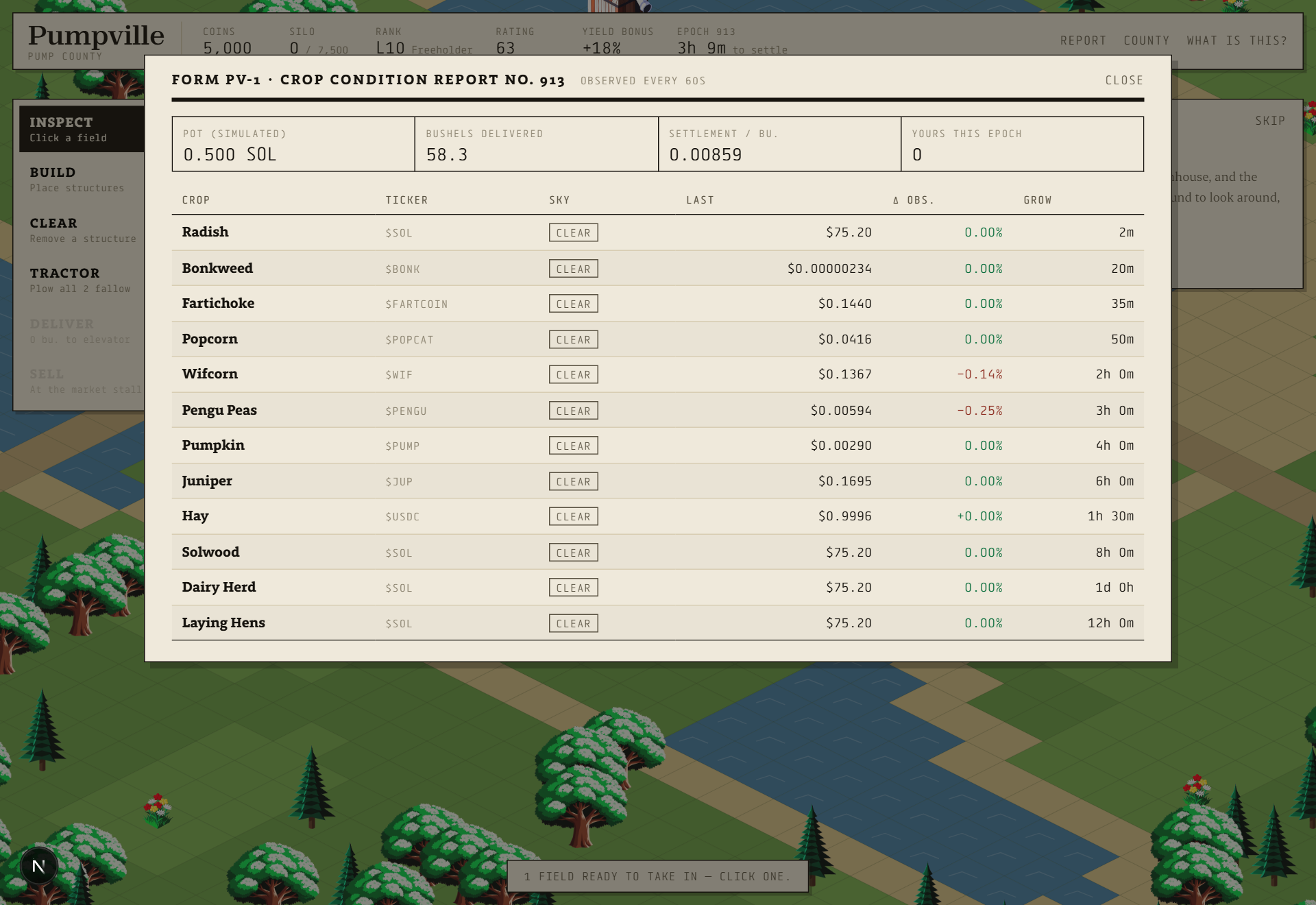
the whole county at a glanceThe report lists every crop, its sky, its last observed price and the change since the previous observation. Observations are taken every sixty seconds, and the change shown is between consecutive observations — not a rolling daily figure.
8 · $VILLE — fighting the weather
the only lever you haveEverything so far, the chart decides. $VILLE is how you argue with it. You earn it at settlement — grain delivered to the elevator pays out in it — and you spend it in three ways.
Seed the clouds
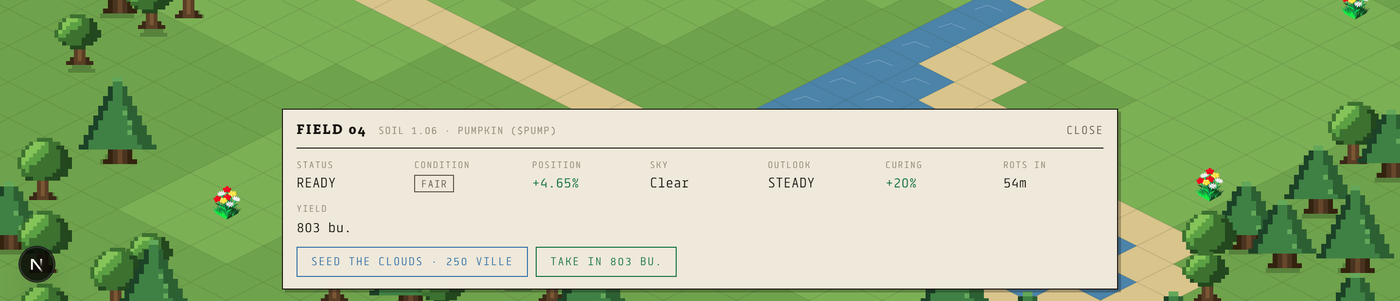
Burn $VILLE and rain falls on one field for 20m, whatever the market is doing. A drought stops biting; the crop grows as though the chart were green. Rain also keeps hail off — but it will not turn away locusts, so seeding is not insurance against a collapse. Price scales with the crop: 48 for a twenty-minute row crop, 470 for an eight-hour orchard.
The water table
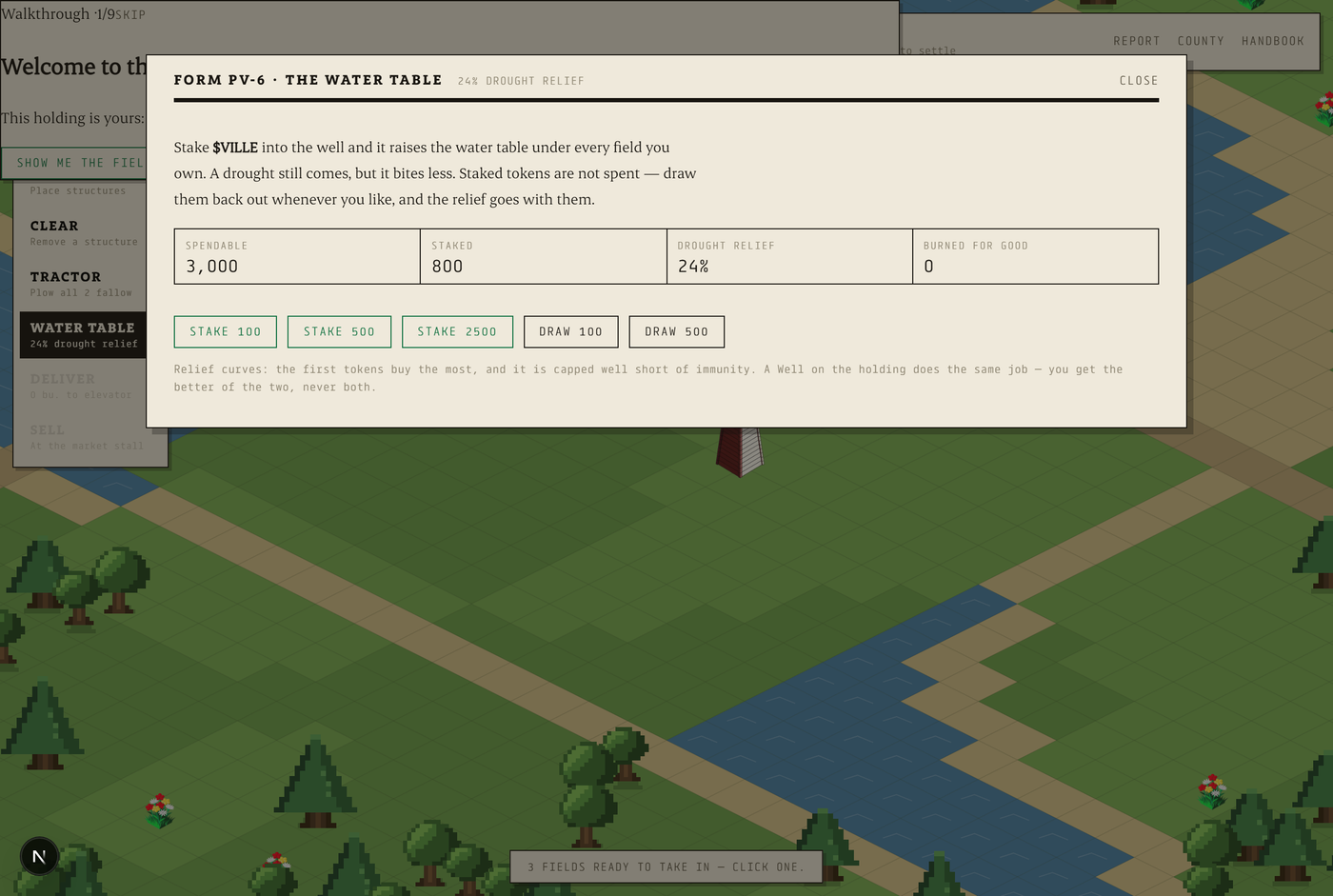
Stake $VILLE into your well and it raises the water table under every field you own, softening drought permanently while it is staked. Staking is not spending — draw it back whenever you like, and the relief leaves with it. The curve gives the most for the first tokens and is capped well short of immunity.
Land, and the burn
Deeds are bought with $VILLE and it is burned, not banked — the county's supply shrinks every time the map grows. Seeding burns too. What you stake comes back; what you burn never does.
9 · A working routine
what a session looks like- Take in anything ready, before it rots.
- Clear whatever the locusts or the clock took.
- Plow the empty ground — the tractor does it in one action.
- Sow against the sky: fast row crops when the chart is running, hay when you want no weather at all.
- Feed the fields you care about most.
- Deliver, or hold and accept the spoilage if you think the next pot is worth waiting for.
- Spend the coins on structures. They compound.
- Check the outlook. If a drought is coming for something you care about, seed the clouds before it bites.
Issued by the Bureau of Agricultural Statistics, Pump County. This is a game about a market; it is not investment advice, and the crops are not real crops.